Guest Editorial | Vol 12 | Issue 1 | January-June 2026 | page: 06-08 | Madhan Jeyaraman, Naveen Jeyaraman
DOI: https://doi.org/10.13107/ti.2026.v12.i01.072 Submitted: 11/03/2026; Reviewed: 29/03/2026; Accepted: 06/04/2026; Published: 10/04/2026
Authors: Madhan Jeyaraman [1], Naveen Jeyaraman [1]
[1] Department of Orthopaedics, ACS Medical College and Hospital, Dr. MGR Educational and Research Institute, Chennai 600077, Tamil Nadu, India. [2] Department of Regenerative Medicine, Agathisha Institute of Stemcell and Regenerative Medicine (AISRM), Chennai 600030, Tamil Nadu, India. Address of Correspondence Dr Madhan Jeyaraman, Department of Orthopaedics, ACS Medical College and Hospital, Dr. MGR Educational and Research Institute, Velappanchavadi, Chennai 600077, Tamil Nadu, India. E-mail ID – madhanjeyaraman@gmail.com
Editorial
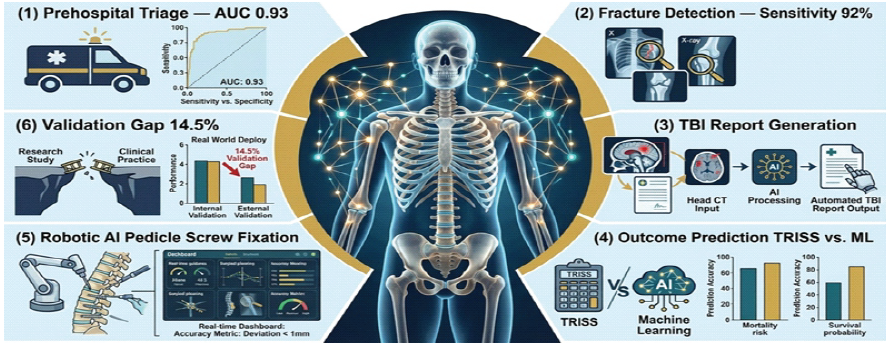
Editorial Trauma is still one of the most daunting public health dilemmas of the XXI century. Injuries are the leading cause of death (9.2% on a global level) and cause of disability-adjusted life years (DALY) and disproportionately impact economically productive young adults- a demographic with deep consequences to low- and middle-income countries. In India, the pressure is especially high. Despite owning less than 1% of the total vehicles in the world, the country accounts for almost 10% of all crash-related deaths. Still, the infrastructure in prehospital care is poorly developed and underdeveloped in comparison with the clinical need. Traditional triage tools, such as the Revised Trauma Score (RTS), the Glasgow Coma Scale (GCS), and the Trauma and Injury Severity Score (TRISS), were created at a time when data integration was limited, and they have well-defined limits to the discriminative performance. The coming together of big data, scalable computing power, and current machine learning (ML) frameworks now provides a historic inflexion: a real opportunity to re-architect trauma care beginning with initial scene evaluation through long-term rehabilitation, with evidence-based intelligence at every decision point in the care continuum [1–6]. Artificial intelligence (AI) has the potential to be realised in prehospital triage and transport decision-making. A stringent systematic review and meta-analysis conducted by Adebayo et al. revealed that AI, ML and deep learning (DL) models were consistently superior compared to conventional trauma triage tools in predicting mortality, hospitalisation, and critical care admission in all studies included except two. Gradient boosting-, neural network-, and random forest-based models of trauma have demonstrated area under the receiver operating characteristic curve (AUC) ranging between 0.75 and 0.93 and have also decreased the rates of undertriage to less than 10%. A neural network based on prehospital vital signs and a simplified version of the consciousness score in a single landmark deployment had an AUC of 0.89, significantly outperforming the Revised Trauma Score (AUC 0.78) in forecasting the need to undergo life-saving intervention. These models are able to combine multi-source real-world data – physiological waveforms, electronic health record entries, and pre-hospital imaging – to make predictive transport decisions that direct the most critically injured to the correct level of care before any contact with a hospital is made, a capability completely unattainable with a single-variable scoring system [1,7,8]. AI has grown fastest within the hospital in the field of diagnostic imaging. Deep learning algorithms using plain radiographs, computed tomography (CT) and magnetic resonance imaging (MRI) have shown pooled sensitivities and specificities of fracture detection which typically range between 0.85 and 0.95 in multiple meta-analyses. In 2022, a meta-analysis of 42 studies by Kuo et al. had a sensitivity of 92% and a specificity of 91% with general fractures. A contemporaneous meta-analysis by Zhang et al. on 39 studies with general fractures had an accuracy of 96% and, a sensitivity of 90% and a specificity of 92% [9]. In complex anatomy like the pelvic and spinal fractures and distal radial fractures, the DL classification systems are now as accurate as those of the radiologists and orthopaedic surgeons in their diagnosis. In addition to fracture detection, radiology report generation via AI (in the case of traumatic brain injury, or TBI) is a clinically transformative technology: transformer-based natural language generation models are able to generate radiologist-quality reports on CT neuroimaging with even stronger accuracy than the previous convolutional neural network architecture. To an Indian trauma network with limited resources, in which after-hours radiological coverage in the district hospitals is limited, and specialist teleconsultations bandwidth is constrained, AI-aided image interpretation is not a vision of the future, but a directly implementable intervention to decrease diagnostic delay and undertriage in tier-2 and tier-3 centres [2,4,9]. Predictive modelling expands the scope of AI beyond the acute episode. ML models fitted on large national trauma registries have been shown to have better discriminative capabilities in predicting mortality, ICU admission, and post-injury complications compared to conventional prognostic tools like TRISS. Ensemble algorithms, specifically random forest classifiers, have been especially effective on data sets in the National Trauma Data Bank, in which the high-dimensional interaction between injury pattern, physiological derangement, comorbidity burden, and operative intervention defies the linearity assumptions of logistic regression. In the particular scenario of TBI, GCS motor component, pupillary reactivity status and cisternal condition on CT were shown to be the most common predictive characteristics of both in-hospital mortality in the short term and six-month functional outcome, and random forest algorithms have proven superior to binary logistic models on externally validated cohorts. Such prognostic tools are of special interest to the intensivist-led trauma unit in tertiary Indian centres, where bed allocation and family counselling decisions are made by applying a decision-support algorithm to early outcome stratification. In this field, human clinical judgement, however unsurpassable in context-specific subtlety, can be intelligibly aided by algorithmic insight [1,9]. The schematic representation of artificial intelligence in trauma management is depicted in Figure 1.

Figure 1 – Schematic representation of artificial intelligence in trauma management
In spite of this trend, a critical review of the AI-trauma literature warrants a cautious yet optimistic approach. A review by Misir of 217 studies published between 2015 and 2025 determined that merely 14.5% of the studies were externally validated, and only 3.2% had a prospective clinical validation – a statistic that reveals the gap between laboratory performance and clinical tools that can be deployed [1]. An up-to-date scoping review establishes that the actual prospective clinical testing was rare at 1.4%, and that only 3.4% of the developed models were implemented into actual practice. In the Indian context, homogeneous training datasets lead to algorithmic bias, and the generalisability of these algorithms may be jeopardised by the fact that injury mechanisms, comorbidity patterns, and care trajectories vary significantly between Western cohorts and Indian ones. The black-box properties of deep neural networks also make clinical adoption more challenging: a trauma surgeon who takes a mortality prediction made by an AI has to have faith in a system whose inferential logic is not visible, which raises ethical and medicolegal concerns that the orthopaedic community has not sufficiently addressed. The moral imperative is not at stake; AI has to serve as an augmentative intelligence to increase the ability of the orthopaedic trauma surgeon to make timely, accurate, and humane judgments, not to replace the clinical judgment that is the irreducible core of surgical care. An opportunity is generational to the Indian Orthopaedic Association and its member institutions: to invest in curated, nationally representative trauma data registries, to require external and prospective validation parameters in all AI research submissions, and to instil AI literacy, including critical appraisal of algorithmic assertions, in the next generation of Indian orthopaedic surgeon fellowship training [1, 2, 9, 10].
References
1. Misir A. (2025). Artificial intelligence in orthopedic trauma: a comprehensive review. Injury, 56(8), 112570. https://doi.org/10.1016/j.injury.2025.112570 2. Mohamed A., Elasad A., Fuad U., Pengas I., Elsayed A., Bhamidipati P., et al. (2025). Artificial Intelligence in Trauma and Orthopaedic Surgery: A Comprehensive Review From Diagnosis to Rehabilitation. Cureus, 17(9), e92280. https://doi.org/10.7759/cureus.92280 3. Adebayo O., Bhuiyan Z. A., & Ahmed Z. (2023). Exploring the effectiveness of artificial intelligence, machine learning and deep learning in trauma triage: A systematic review and meta-analysis. Digital Health, 9, 20552076231205736. https://doi.org/10.1177/20552076231205736 4. Zarei R., Downs M. C., & Torgerson L. (2025). Artificial Intelligence in Prehospital Emergency Care: Advancing Triage and Destination Decisions for Time-Critical Conditions. Cureus, 17(9), e91542. https://doi.org/10.7759/cureus.91542 5. Kutbi M. (2024). Artificial Intelligence-Based Applications for Bone Fracture Detection Using Medical Images: A Systematic Review. Diagnostics, 14(17), 1879. https://doi.org/10.3390/diagnostics14171879 6. Bhatnagar A., Kekatpure A. L., Velagala V. R., & Kekatpure A. (2024). A Review on the Use of Artificial Intelligence in Fracture Detection. Cureus, 16(4), e58364. https://doi.org/10.7759/cureus.58364 7. Bouslimi R., Trabelsi H., Karaa W. B. A., & Hedhli H. (2025). AI-Driven Radiology Report Generation for Traumatic Brain Injuries. Journal of Imaging Informatics in Medicine, 38(5), 2630-2645. https://doi.org/10.1007/s10278-025-01411-y 8. Cardosi J. D., Shen H., Groner J. I., Armstrong M., & Xiang H. (2021). Machine learning for outcome predictions of patients with trauma during emergency department care. BMJ health & care informatics, 28(1), e100407. https://doi.org/10.1136/bmjhci-2021-100407 9. Kuo R. Y. L., Harrison C., Curran T.-A., Jones B., Freethy A., Cussons D., et al. (2022). Artificial Intelligence in Fracture Detection: A Systematic Review and Meta-Analysis. Radiology, 304(1), 50-62. https://doi.org/10.1148/radiol.211785 10. Olczak J., Fahlberg N., Maki A., Razavian A. S., Jilert A., Stark A., et al. (2017). Artificial intelligence for analyzing orthopedic trauma radiographs. Acta Orthopaedica, 88(6), 581-586. https://doi.org/10.1080/17453674.2017.1344459
| How to Cite this article: Jeyaraman M, Jeyaraman N | Artificial Intelligence in Trauma Management: Current Applications, Emerging Frontiers, and the Road Ahead | January-June 2026; 12(1): 06-08 | https://doi.org/10.13107/ti.2026.v12.i01.72 |
(Abstract Text HTML) (Download PDF)